 CallMyAgent
 or Pilothouse?
Choose Pilothouse if you want a free, open-source workspace that gathers Claude Code, Codex and other agents, then lets you inspect and answer them from an iPhone or browser. Choose CallMyAgent if you want your phone to ring after you leave your Mac and need to give one verified spoken answer without opening a remote workspace.
which one fits?
choose Pilothouse if...
- You want one Inbox and tabbed workspace for several agents and projects, not just a way to hear the next question.
- You want to see a live terminal, review a diff, or approve from an iPhone or browser.
- You want a free, open-source tool and are happy to use its desktop app as your agent workspace.
choose CallMyAgent if...
- You keep working in your existing Claude Code or Codex setup and want a call only when you have walked away.
- You would rather hear one request and answer out loud than open an app to inspect a queue.
- You want a sound at your Mac, a call away from it, and two free talking test calls before adding a card.
the interruption takes a different path.
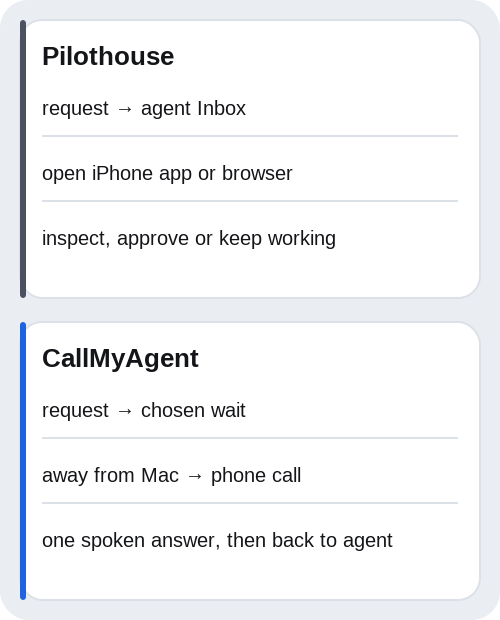
Pilothouse describes one desktop window for Claude Code, Codex, Gemini CLI, Antigravity and opencode. It puts agents that need you in an Inbox. From its iPhone app or web app, you can see the live terminal, review changes and use the agent's approval options. Its iPhone listing also describes notifications and Live Activities when an agent needs you or finishes.
CallMyAgent leaves the agent in the terminal or desktop app you already use. When Claude Code or Codex waits past your chosen delay, the Mac checks whether you are away. If you are there, it plays a sound. If you have left, it rings your phone, reads the request and takes one spoken answer. It does not give you a live terminal, diff viewer or multi-agent Inbox on your phone.
picture a command waiting for approval.
Suppose Claude Code asks whether it may run a command while you are away from the desk. In Pilothouse, you can open the request on your iPhone or in a browser, read the agent's options, inspect the terminal and look at the changes before answering. The product says it makes risky commands take two taps and Face ID, and refuses a tap on a prompt that has changed in the meantime. Those controls suit a decision that needs more context than a short spoken summary.
With CallMyAgent, the request waits for your chosen delay. If your Mac still sees you as away, your phone rings. The call reads the command before approval and checks that your own words support the action. If your reply is unclear, it asks once and leaves the decision for you at the Mac. That is useful when you can answer in a sentence and want to carry on with whatever took you away from your screen.
both use voice, for different jobs.
Pilothouse's site describes speaking an idea to an agent in its app and turning the agreed plan into queued work. Its phone experience also lets you type messages and operate the remote terminal. That is a larger work surface: you can start, inspect and steer work from the phone. If that is what you need, the workspace is the stronger choice.
CallMyAgent uses voice inside a conventional phone call for the next waiting question. The call is intentionally short and handles one answer. You still return to your Mac for longer instructions, code review or a sequence of decisions. A ringing call may get your attention when a push is easy to miss, but it cannot replace a full mobile view of the session.
cost, setup and limits.
Pilothouse's site calls the desktop app and phone or browser access free and open source under MIT. Its published setup starts with the desktop app and pairs a remote device by QR code. It says there is no account and that its relay cannot read end-to-end encrypted traffic. Those are the developer's claims, not an audit by CallMyAgent. Read its current source and releases if those details affect your decision.
CallMyAgent is a Mac menu bar app for macOS 13 or later. It watches local Claude Code and Codex sessions; your Mac and agent must stay running for a call to happen. Spoken replies work with Claude Code in the terminal or desktop app and Codex CLI. A Codex session in the ChatGPT app can call you, but you answer it at your Mac. The two free test calls need no card. After that, the 7-day trial allows up to 15 calls and needs a card; the plan is $9.99 a month with 50 calls included. See current pricing. It does not offer Pilothouse's multi-agent workspace or remote terminal.
Both products depend on the agent still running on your computer. If you want a free place to manage several agents and inspect their work from your phone, start with Pilothouse. If you already like your current agent setup and the missing piece is a ringing phone when one request stalls, try CallMyAgent's test calls.
questions.
Is Pilothouse free?
Pilothouse describes its desktop app and remote phone or browser access as free and open source. Check its current site before installing. CallMyAgent offers two free test calls without a card, then a card-required trial and paid calling plan.
Can Pilothouse answer an agent from my phone?
Yes. Pilothouse shows approvals, the live terminal and changes in its iPhone app or web app. You can approve, decline or send a message there. CallMyAgent instead rings you when you are away and takes one spoken answer by phone.
Which should I use for several coding agents?
Choose Pilothouse if you want one workspace and Inbox for Claude Code, Codex and other agents. Choose CallMyAgent if you already use your own agent windows and mainly want a phone call when one of them waits while you are away.
what we checked.
These are Pilothouse's own materials and Anthropic's hook documentation, checked 23 November 2026. Features and availability can change. CallMyAgent details come from the product and pricing information on this site.